


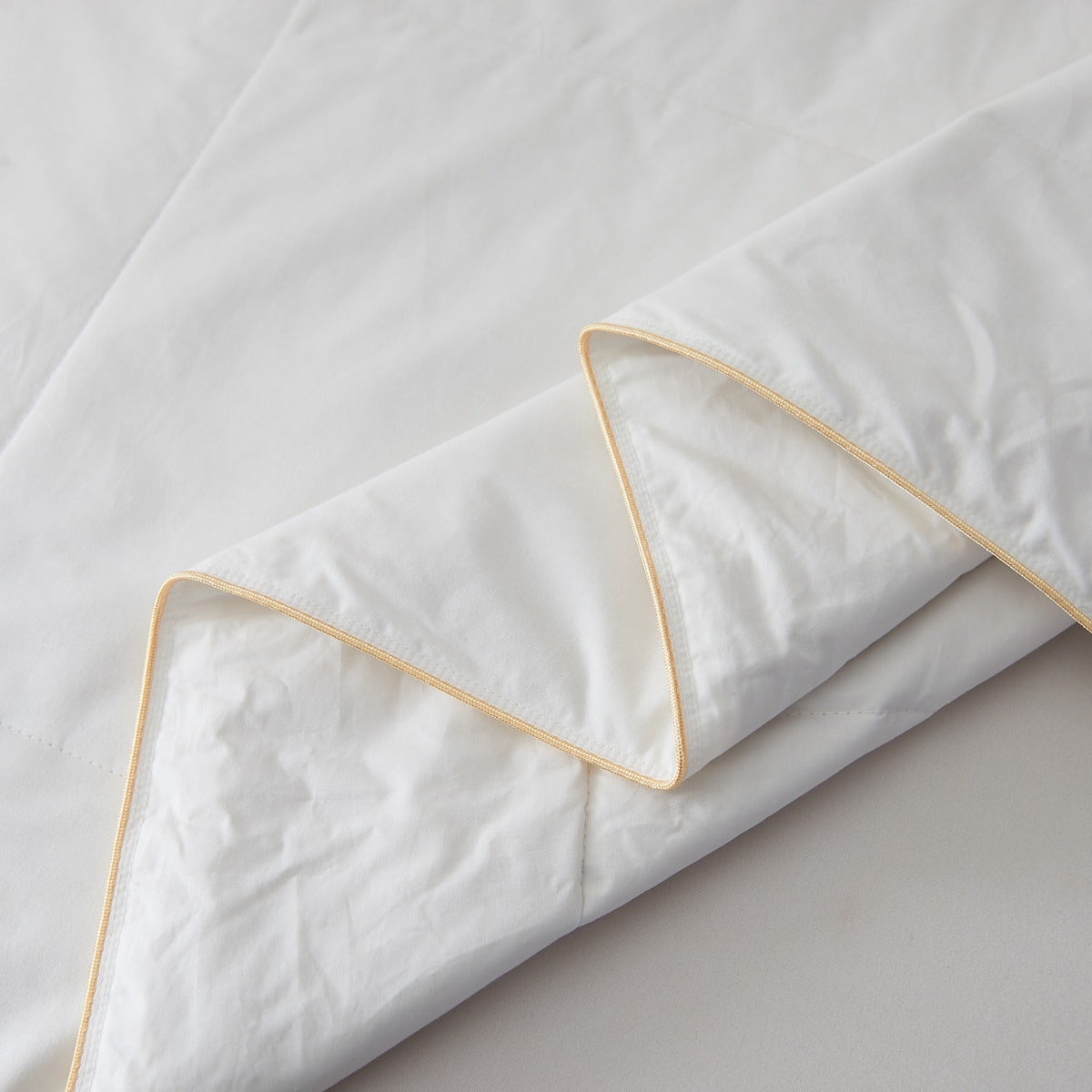

Silk Duvet
Details
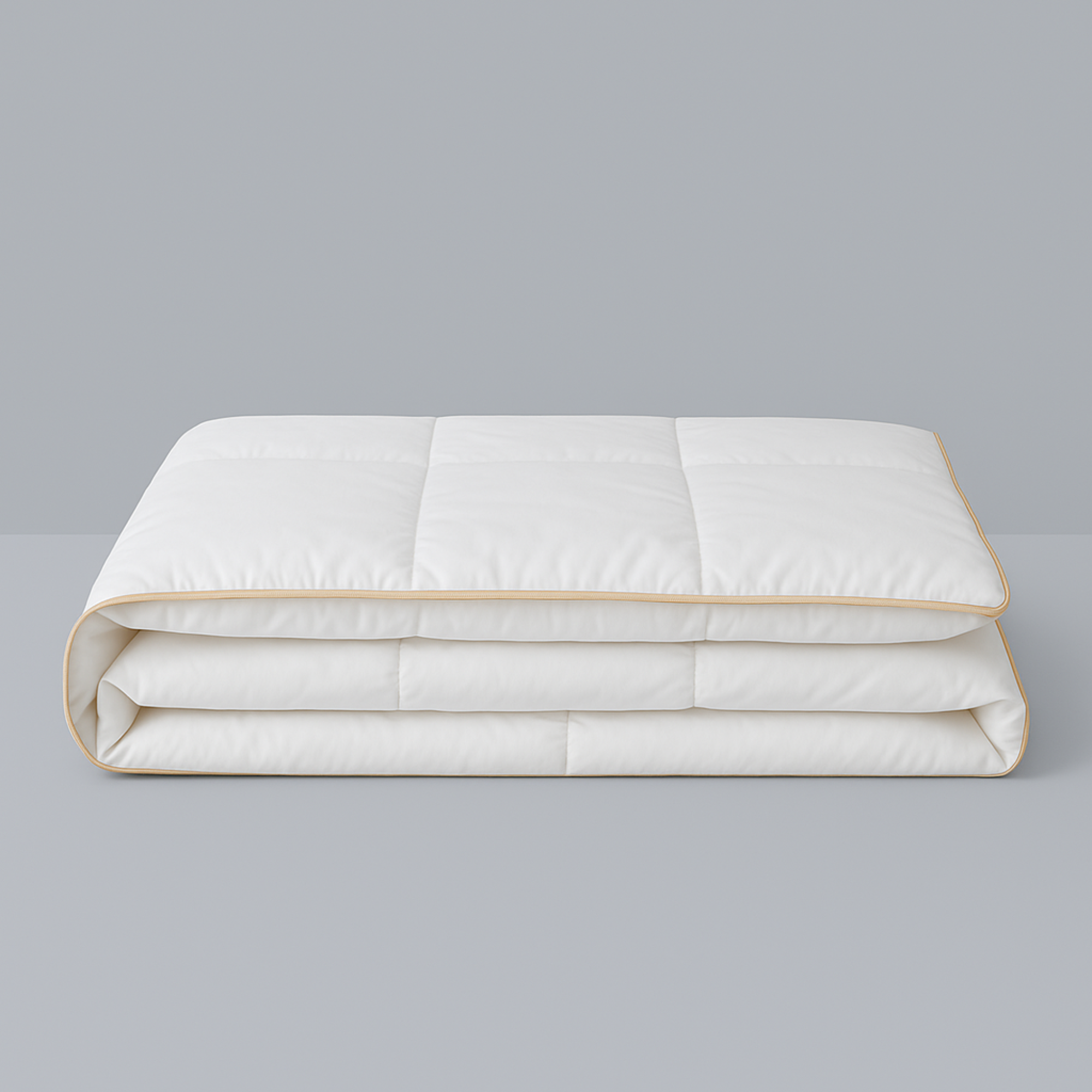
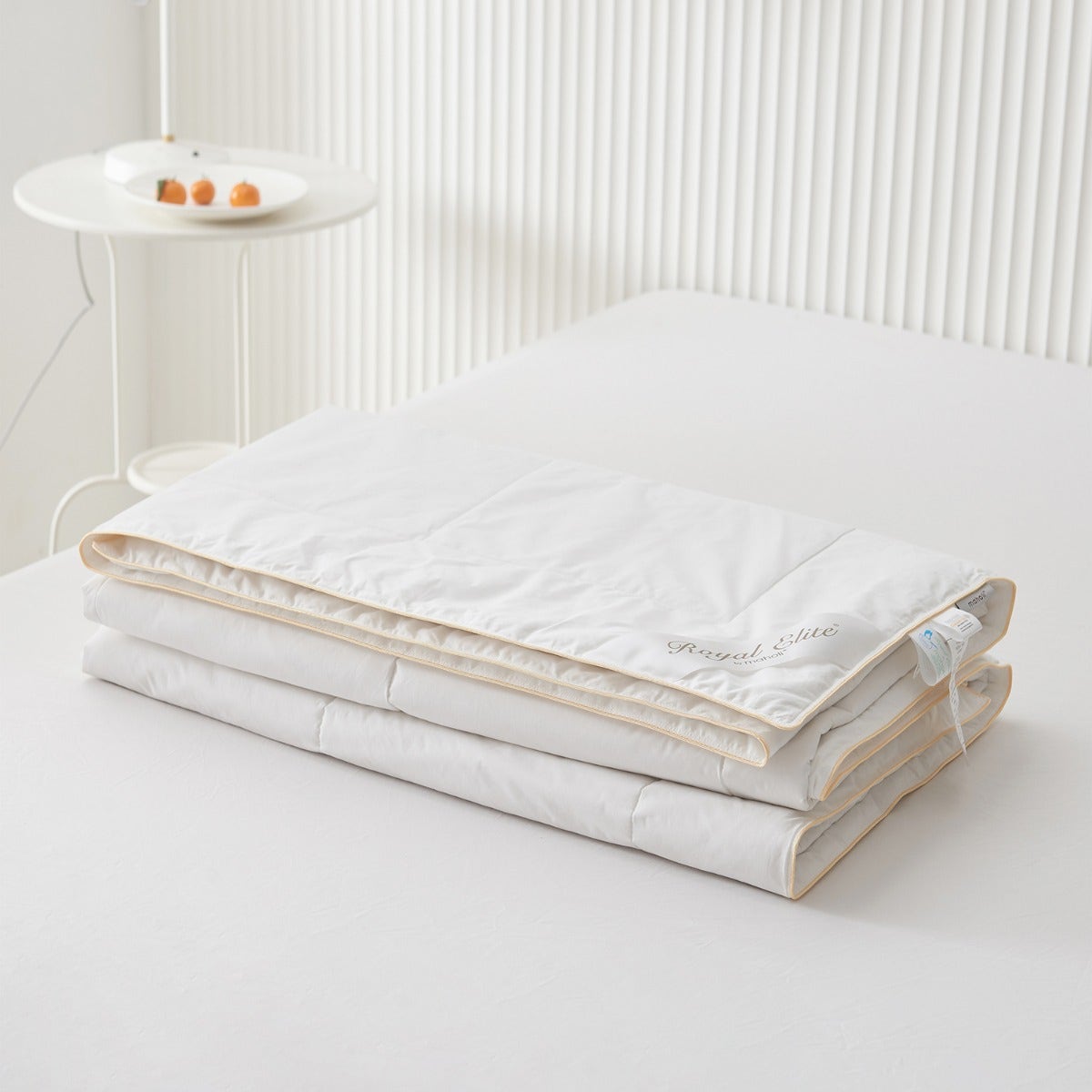
Crafted for effortless comfort and natural elegance — perfect for sensitive sleepers who prefer breathable, year-round softness.
- 240 thread count cotton percale shell — flat weave, breathable, and matte to the touch.
- Filled with 100% Mulberry silk (275+ g/m²) for — All Season weight with a close, contouring drape.
- Published fill weight for every size: Twin 38 oz · Double 45 oz · Queen 52 oz · King 60 oz.
- Eco-friendly luxury, made with sustainable, natural fibers.
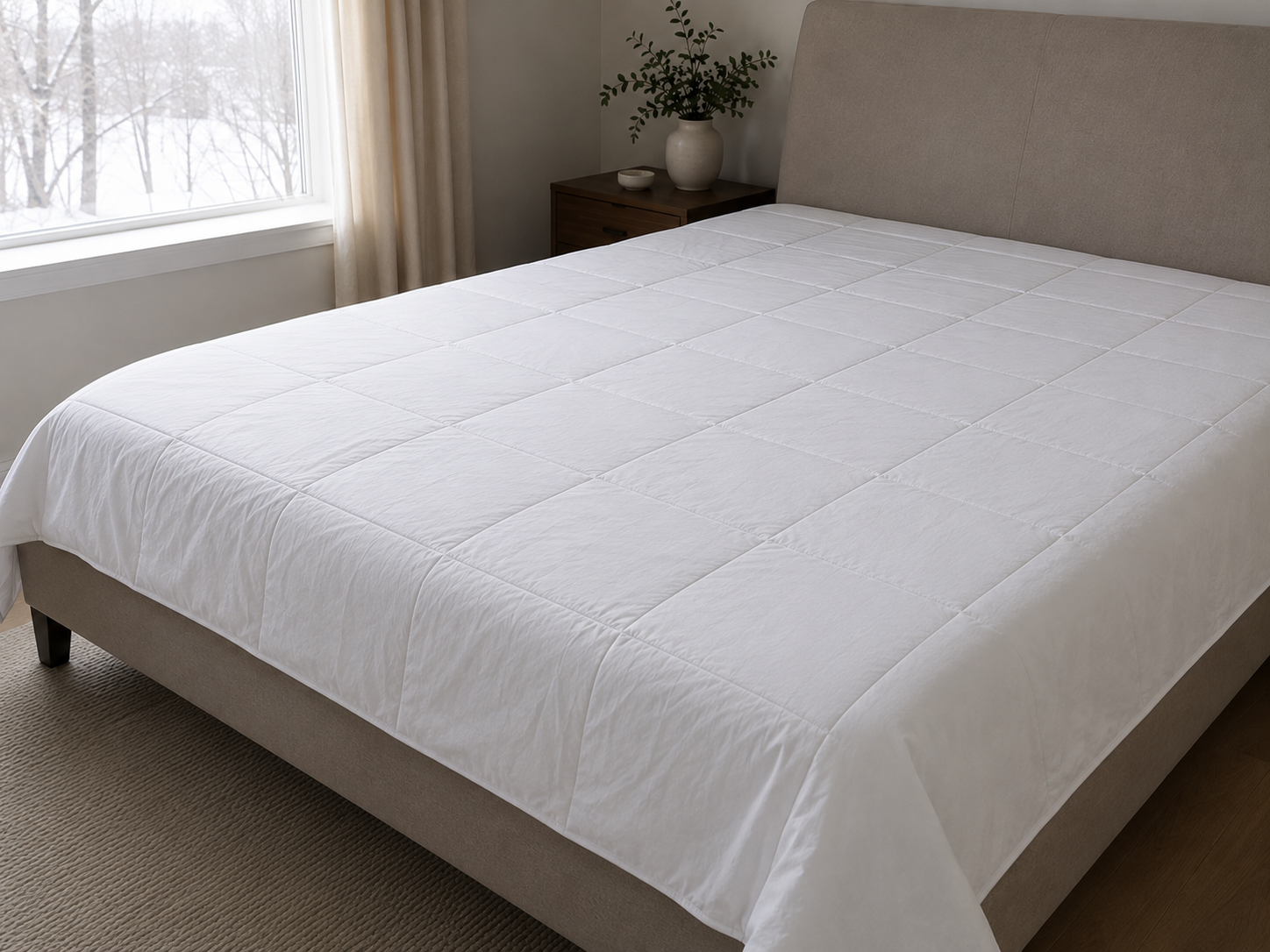
- Box stitch construction keeps the silk evenly distributed and prevents migration.
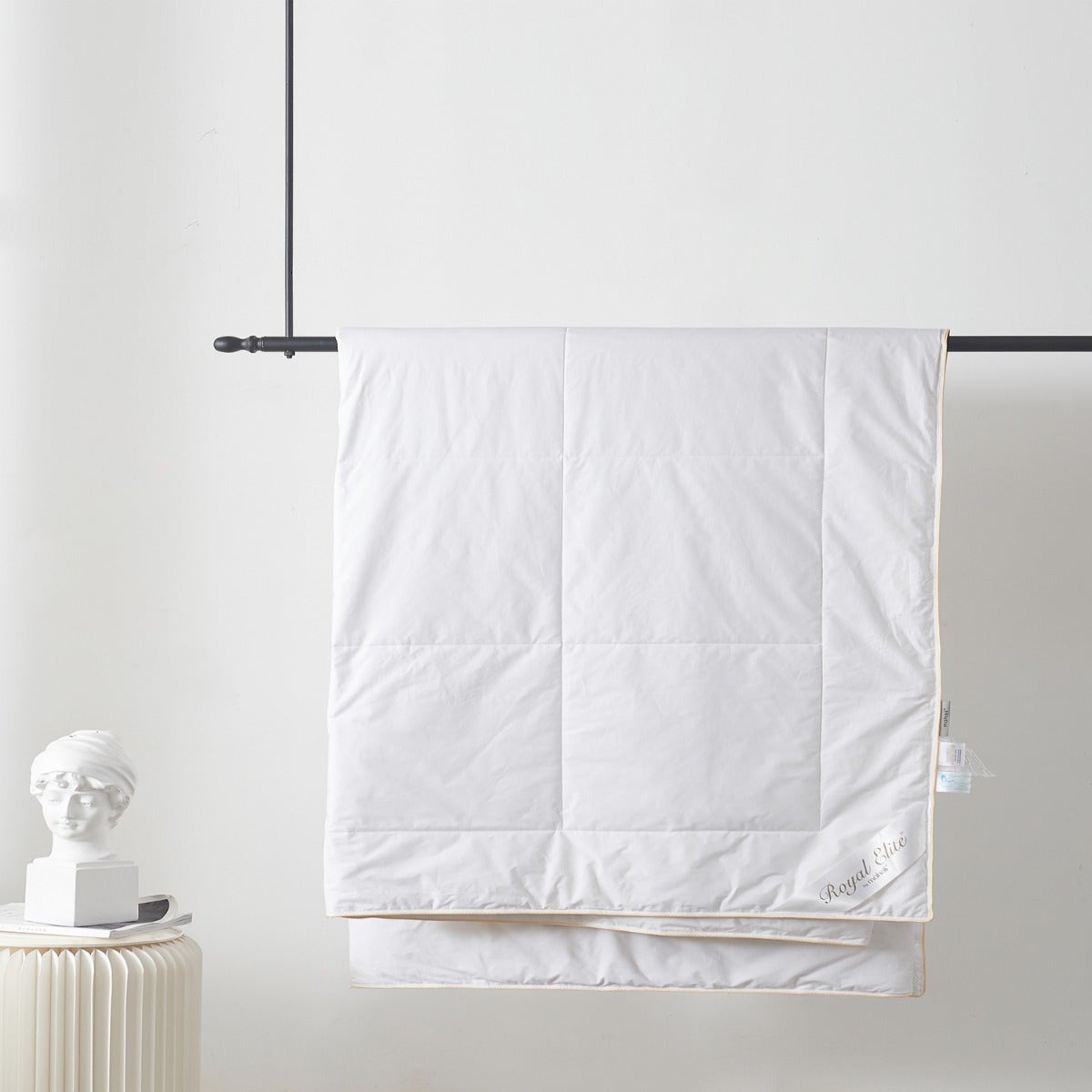
- Corner ties anchor the duvet inside your cover.
- Reinforced double-stitched seams for strength and longevity.
- Hypoallergenic and gentle on skin, ideal for sensitive sleepers.
- Certified Standard 100 by OEKO-TEX®, ensuring safety and purity.
- Imported. Canadian company since 1994.
Care Instructions
Certifications

Returns/Warranty
Silk Duvet
What's Inside Silk Duvet Comforter?
All Season Mulberry Silk, ~275+ g/m²
Same fill density in every size, Twin through King, so the duvet performs identically whichever one you buy. Exact fill weight published for all four sizes — see the size table.
240 Thread Count Cotton Percale
A flat, matte weave with more airflow than the sateen and jacquard shells most silk duvets use. Crisp and cool to the touch, not slick.
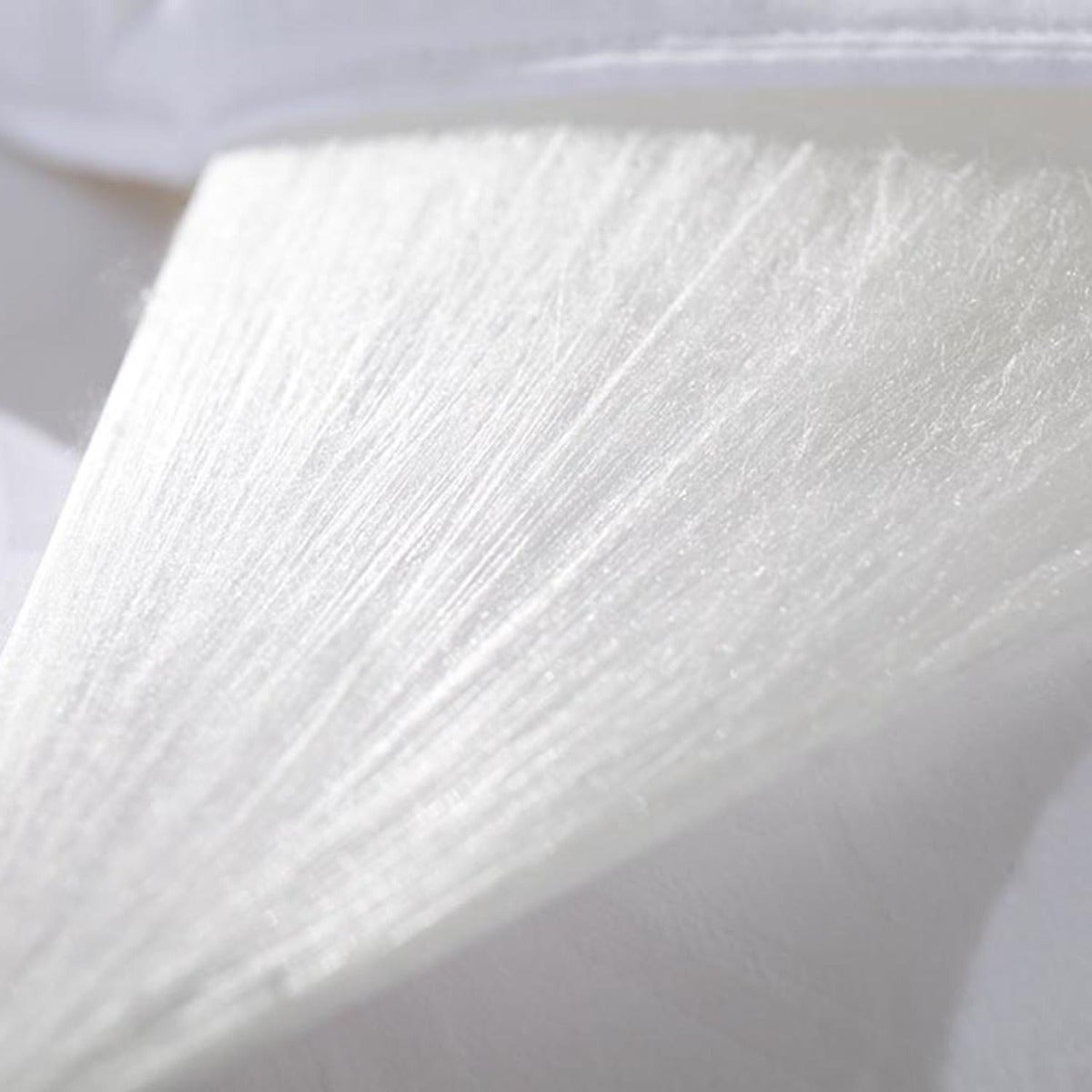
Mulberry Silk Floss
Hand-layered silk from mulberry-fed silkworms. Softer and more affordable than long-strand; secured by box-stitch construction so it stays where it belongs.
Corner Ties + Reinforced Seams
Ties at every corner keep the duvet anchored inside your cover. Double-stitched seams throughout.
STANDARD 100 by OEKO-TEX®
Independently tested against hundreds of harmful substances across 17 chemical groups — so nothing irritating sits against your skin all night.
Canadian Since 1994
Over thirty years of duvet-making. Imported silk, Canadian company, Canadian support.
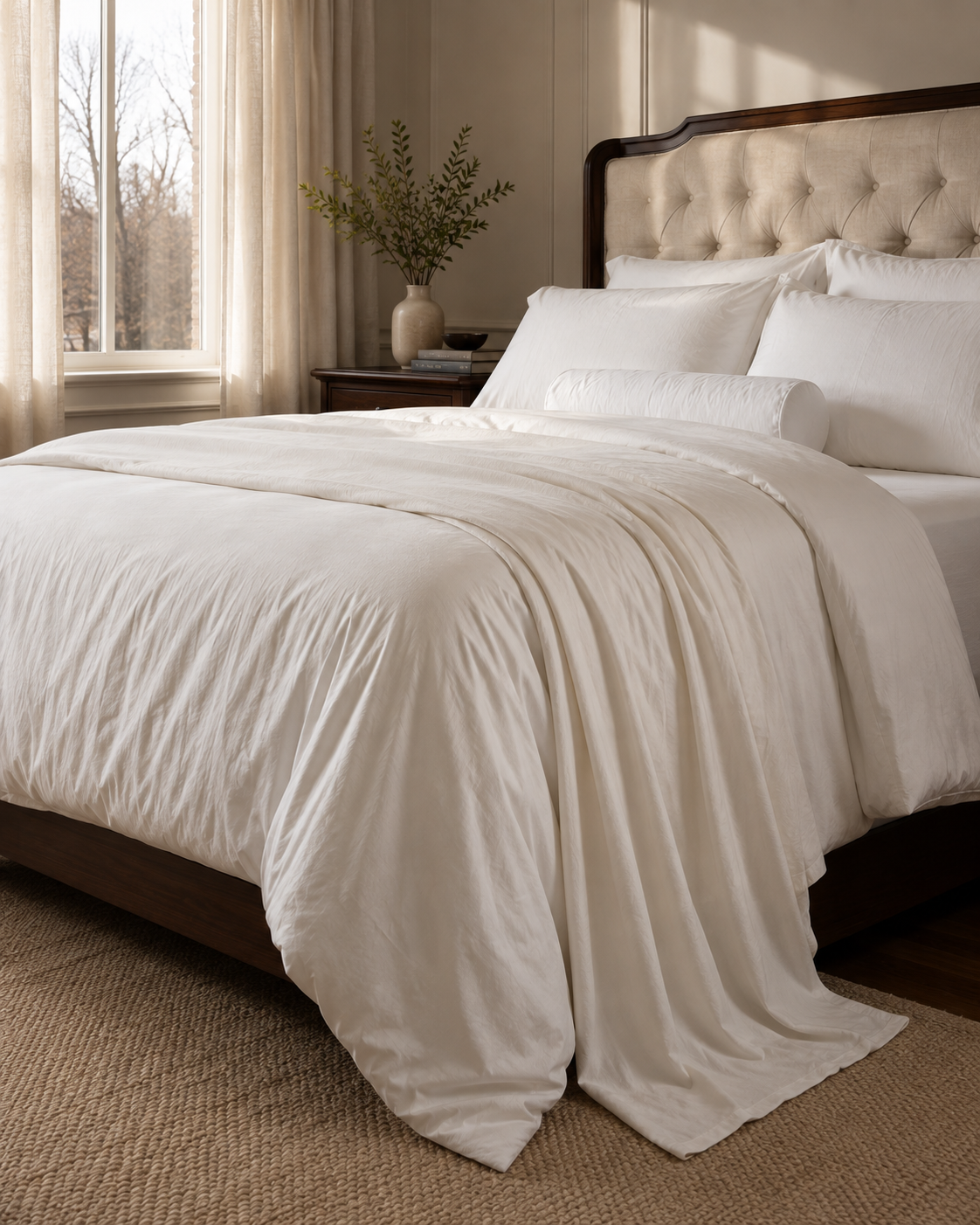
Why Silk Settles Instead of Floats
Down works by lofting. Thousands of clusters trap air and build a dome above your body, held up by fill power.
Silk works the opposite way. It's layered in continuous sheets of fibre — thin, dense, and flexible — so instead of doming above you, it falls onto you and follows your shape. No air gap along your sides. No cold pockets where the loft collapses.
This is why a silk duvet looks thinner than a down duvet of the same warmth, and why it feels different the moment you get under it. It isn't less duvet. It's a different mechanism.
What that means in practice: the weight sits with you rather than over you, and there's less trapped air to turn into trapped heat.
Why Percale, Not Sateen
Almost every silk duvet on the market uses a sateen or jacquard shell. They look glossier on a product photo. We use percale, and it's a deliberate choice.
Sateen is woven so more thread floats across the surface. That's what creates the sheen — and it also lays more fibre in the path of moving air. Percale is a simple one-over-one-under weave. Flatter, matte, and more open, with fewer float threads between you and the silk underneath.
The shell is the only part of a duvet you actually touch. If the fill is doing the work of moving heat and moisture, the shell shouldn't be the thing holding it in.
Percale also wears differently. It softens with washing rather than pilling, and at 240 threads it stays durable enough to protect the silk for years.
Expect it to feel crisp at first. That's percale. It relaxes considerably after a few weeks of use.
Who This Duvet Is For
A good fit if you:
- Like a duvet you can feel, but overheat under down or synthetic fill
- Sleep warm year-round in a heated home
- Deal with night sweats, or temperature swings through perimenopause and menopause
- React to feathers, or need bedding that resists dust mites
- Have sensitive or reactive skin
- Share a bed with someone who runs a different temperature than you
- Have sensitive or reactive skin, or find you wake up clammy under synthetic fill
Probably not the right pick if you:
- Want the lightest possible summer duvet — this is an all-season weight
- Want maximum warmth for an unheated room or a cold cottage in January (see our Hutterite or Hungarian Goose Down Duvets)
- Need something you can machine wash at home (see our Washable Wool Duvet)
- Want genuine cool-to-the-touch handfeel (see our Bamboo Viscose Duvet)
How It Compares
Fill weight is the honest way to compare silk duvets. Silk grading has no independent certifying body — any brand can print "6A" on a label. Ounces of silk in a given area can be weighed and checked. We publish ours for every size. Most brands don't publish theirs at all.
Fill weight by size
| Size | Dimensions | Fill weight |
|---|---|---|
| Twin | 66" × 88" | 38 oz |
| Double | 80" × 88" | 45 oz |
| Queen | 90" × 88" | 52 oz |
| King | 104" × 88" | 60 oz |
Choosing among our four natural fills
| Attribute | Silkthis duvet | Goose Down | Washable Wool | Bamboo Viscose |
|---|---|---|---|---|
| Feel | Drapes and contours | Lofts above you | Substantial, springy | Smooth, light |
| Warmth | All-season | Light to very warm | All-season | Light |
| Best for | Warm sleepers who want weight | Cold rooms, deep winter | One duvet, every season | Genuine cooling handfeel |
| Home washable | No | No | Yes | See product page |
| Weight on the body | Moderate, close-fitting | Light, airy | Moderate | Light |
Silk Duvet Comforter FAQs
Is this Silk Duvet warm enough for a Canadian winter?
In a heated home held around 18–21°C, yes — at 52 oz in a Queen this is an all-season weight, not a summer duvet. In an unheated room, a cottage, or if you genuinely sleep cold, a goose down duvet will give you more warmth for less weight. We'd rather point you there than have you cold.
Is a Silk Duvet good for hot sleepers?
Yes, with one clarification. Silk regulates temperature by absorbing moisture — it can take up around 30% of its weight in moisture without feeling damp — so you stay dry, and staying dry is most of what "sleeping cool" actually means. What silk doesn't do is feel cold to the touch. If you want that specific sensation, our Bamboo Viscose Duvet is the better match. If you want a duvet with real presence that won't cook you, this is it.
Why does my new Silk Duvet have a faint smell?
Untreated Mulberry Silk has a mild, earthy natural scent from sericin, the protein that binds the fibre. It's a marker of minimally processed Silk, not a chemical residue. Air the duvet in a shaded, well-ventilated spot for 24–48 hours and it clears.
Why does it look thinner than a Down Duvet?
Because it's built differently. Down lofts into a dome above you; Silk is layered in continuous sheets that fall onto you and follow your shape. A Silk Duvet at equivalent warmth will always look flatter. Let it breathe for about 12 hours out of the packaging before first use.
What's the difference between short-strand and long-strand Mulberry Silk?
Long-strand Silk is drawn from cocoons in continuous unbroken fibres and layered by hand — it holds its structure longer and costs considerably more. Short-strand silk is made of shorter fibres, which makes it softer and more affordable, and our box stitch construction keeps it evenly distributed. This duvet uses short-strand mulberry silk. Our 300TC Mulberry Silk Duvet uses 6A long-strand.
How much Silk is actually in it?
Twin 38 oz · Double 45 oz · Queen 52 oz · King 60 oz. That works out to roughly 275+ g/m² across every size. We publish these figures so you can compare us directly against any other Silk Duvet — most brands don't publish theirs.
How do I clean a Silk Duvet? Can I wash it?
Always use a duvet cover and wash the cover, not the duvet. Do not machine wash the duvet. We don't recommend conventional dry cleaning either — the solvents strip sericin and shorten the life of the fibre. For spills, spot clean with cool water and a small amount of a gentle non-detergent soap such as Woolite or Zero, then dab dry and let it air fully. Refresh once or twice a year by airing it in a shaded, ventilated spot for a few hours. Keep it out of direct sun, which weakens silk over time.
Do I need a Duvet Cover?
Yes. The percale shell is built to hold the Silk in place, not to take daily wear from skin, oils and friction. A cover is what makes a Silk Duvet last, and it's the difference between years and decades.
Will the Silk shift or clump inside the cover?
Box stitch construction divides the fill into sewn-through panels so it can't migrate to one end, and the corner ties anchor the duvet to your cover so it stays put through the night. Give it a shake when you change the cover and it redistributes evenly.
Will it fit my Duvet Cover?
Our duvets run 88" long. Many Queen and King covers are cut at 90", so you may have about two inches of slack at one end — this is why we build in corner ties. Tie all of them when you dress the bed and the duvet stays square. Our Twin, Double and King are cut wider than the category standard, which gives you more drape down the sides of the bed.
How long will it last?
With a cover on it and gentle care, a silk duvet is a long-term purchase — many owners get well over a decade. Silk is one of the strongest natural fibres there is. What shortens its life is washing it, dry cleaning it, or leaving it in direct sun.
Is Silk bedding good for allergies?
Silk is naturally resistant to dust mites, mould and mildew, and it contains no feather or down protein. Every Royal Elite silk duvet is certified STANDARD 100 by OEKO-TEX®, tested against hundreds of harmful substances. If you react to feathers or synthetics, silk is one of the best natural options available.
Is a Silk Duvet good for your skin?
It helps in two ways, though it's worth being precise about how. Silk absorbs moisture without feeling damp, so you're not sleeping against trapped sweat — which is what tends to irritate reactive skin overnight. It's also naturally resistant to dust mites and mould, and certified STANDARD 100 by OEKO-TEX®, so there's nothing harsh sitting against you for eight hours. What a silk duvet won't do is act on your face directly — the surface you touch is the cotton percale shell, not the silk fill. If you're after the friction and hydration benefits people associate with silk bedding, that comes from silk in direct contact with skin, so a silk pillowcase or silk sheets are the right product for that.
- VAVera A.Verified BuyerRated 5 out of 5 stars2 months agoSilk Duvet Twin
As described. Comfortable.
- OOxannaVerified BuyerRated 5 out of 5 stars5 months agoSkin is very important
best ever
- LCLin C.Verified BuyerRated 5 out of 5 stars5 months agoSkin is very important
I want my skin to healthy and maintain exactly how it is. I have been using this silk duvet for over 2 years now and been no problem at all so far and I feel so relieved.
- TBTerri B.Verified BuyerRated 5 out of 5 stars11 months agoPremium silk duvet
My first silk duvet as I am a hot sleeper and suffer from allergies. I love the lighter weight of this vs. a synthetic duvet. I love the quality and softness of the cotton cover and the piping is a quality finish. I like that I am supporting a local Canadian company even if this particular duvet was imported from China. The quality is superb and the price was so much more affordable vs. other Canadian made brands for a King size. I highly recommend it.
- MAMarisa A.Verified BuyerRated 5 out of 5 stars1 year agoPure Elegance and Luxury
The silk duvet has completely changed my sleep experience. It feels unbelievably smooth and luxurious against my skin, and the natural silk fibers keep me cool and comfortable all night long. It’s incredibly lightweight, but still provides a soft warmth that’s perfect for any season. The craftsmanship is impeccable—it truly adds a touch of elegance to my bedroom. If you want to elevate your sleep to a whole new level of comfort and luxury, this silk duvet is a must-have!